Malaysia approaches fiscal year 2026 at a pivotal moment, marked by a decisive state-led intervention in the labor market. The simultaneous full implementation of the RM1,700 Minimum Wage Order and the Progressive Wage Policy (PWP) serves as a historic attempt to correct the capital-labor imbalance. Anchored in the Ekonomi MADANI framework, these measures aim to elevate the labor income share to 45% of GDP, a significant leap from the 2024 level of 33.6%. This aggressive policy shift signals a move away from suppressing wages, which has historically subsidized low-productivity industries.
This new wage architecture has triggered deep polarization between policymakers and the private sector. The administration views this wage shock as a necessary catalyst to force industrial upgrading and address the cost-of-living crisis. Conversely, the Small and Medium Enterprise (SME) sector views it as an existential threat. Business leaders warn that the convergence of higher wages, an expanded Sales and Service Tax (SST), and subsidy rationalization creates a “perfect storm” of cost-push inflation, potentially leading to a wave of insolvencies and a “hollowing out” of the domestic entrepreneurial base.
Forecasting the impact through 2026, the analysis predicts a divergence between macroeconomic stability and microeconomic friction. While GDP growth is projected to remain robust between 4.0% and 5.0%, the on-the-ground reality will likely involve significant consolidation within the SME sector and a widening gap between urban and rural economic resilience. Furthermore, despite the statutory increase, a persistent disparity remains between the new RM1,700 floor and the estimated “living wage” benchmark of RM3,100, suggesting that the cost-of-living pressure on the workforce will not be immediately resolved.
Ultimately, the 2026 wage adjustment functions less as a simple fiscal policy and more as a “structural filter” for the economy. It is implicitly designed to cull enterprises that rely on low-value labor, forcing a painful but necessary transition toward a capital-intensive, high-skilled economic model. The success of this national pivot will largely depend on whether the Progressive Wage Policy can effectively bridge the gap between the mandatory survivalist wage floor and the high-income aspirations outlined in the 13th Malaysia Plan.
1. The Macroeconomic Architecture of Budget 2026
To fully comprehend the friction arising from the 2026 salary adjustments, one must first dissect the fiscal and statutory architecture within which these policies operate. Budget 2026 is not an isolated fiscal event but the financial operationalization of the Thirteenth Malaysia Plan (2026–2030), which formally commences in the same year. The overarching philosophy is the Ekonomi MADANI framework, which prioritizes “Raising the Ceiling” (restructuring the economy for higher value) and “Raising the Floor” (improving social protection and wages).
1.1 The Minimum Wages Order 2024: A Structural Baseline
The RM1,700 floor is not just a nominal hike; it is a structural baseline reset. By including professional services and micro-enterprises (Phase 2), the policy closes the ‘headcount loophole’ that small firms historically used to suppress wages. Crucially, this rate excludes allowances—meaning the effective cost to employers (inclusive of EPF/SOCSO) rises far more than the headline RM200 suggests.
This distinction is vital for cost modeling. Because statutory contributions such as the Employees Provident Fund (EPF) and Social Security Organization (SOCSO) are calculated based on gross wages (basic + allowances), and overtime rates are derived from the basic hourly rate, the effective increase in the “Total Cost of Employment” is significantly higher than the headline RM200 increment suggests.
The compounding effect of this base rate increase on overtime (1.5x for normal days, 2.0x for rest days) creates a multiplier effect on payroll costs, particularly for labor-intensive industries like manufacturing and F&B where overtime is structural rather than incidental.
1.2 Fiscal Cushions and Countervailing Measures
To mitigate the risks of cost-push inflation and business insolvency, the Ministry of Finance has embedded fiscal cushions within Budget 2026 to ease the transition for employers. A primary administrative relief is the tenfold increase in the salary threshold for stamp duty exemptions on employment contracts, raised from RM300 to RM3,000 effective January 2026. This measure is designed to reduce hiring friction for entry and mid-level roles while incentivizing the formalization of the labor market, ensuring broader legal coverage and adherence to the new wage floor.
Simultaneously, the government is linking wage increases to productivity requirements by heavily subsidizing automation and digitalization. With an allocation of RM50 billion for MSME financing and a specific 50% additional tax deduction for AI training and digital upskilling, the policy explicitly encourages firms to augment labor with technology. This strategy aims to help businesses maintain margins in a higher-cost labor environment by accelerating the shift toward the “AI Nation by 2030” vision. for MSMEs incurring expenses related to AI training and digital upskilling. The logic is clear: if labor is becoming more expensive, firms must be incentivized to augment labor with technology to maintain margins.
1.3 The Foreign Worker EPF Mandate: A Structural Shift
Perhaps the most transformative, yet under-discussed, element of the 2026 framework is the introduction of mandatory EPF contributions for non-citizen workers. Historically, foreign labor in Malaysia has been “cheap” not only due to lower base wages but also due to the absence of the 12-13% employer EPF contribution mandated for local citizens.
Budget 2026 initiates a phased approach to closing this gap, starting with a 2% contribution rate. While the initial rate is low, it signals a definitive policy trajectory toward equalizing the cost of local and foreign labor. For SMEs that rely heavily on foreign workers (e.g., plantations, construction, cleaning services), this represents a new, compounding cost layer. The SME Association has flagged this as a critical burden, noting that even a 2% rise adds pressure to cash flows already strained by the minimum wage hike. The long-term policy intent, aligned with the 13th Malaysia Plan, is to reduce the foreign worker dependency ratio from ~15% to ~10% by 2030, effectively pricing low-skilled foreign labor out of the market to encourage automation.
1.4 Taxation and Revenue Measures
The fiscal environment for 2026 also includes revenue-generating measures that impact business costs. The Sales and Service Tax (SST) continues to expand its scope, and a carbon tax is set to be introduced in 2026, initially targeting the iron, steel, and energy sectors. While the carbon tax may not directly hit small SMEs immediately, the pass-through costs from energy and raw materials will inevitably inflate operational expenses, further compressing the margins available for wage absorption.
2. The SME Crisis: Anatomy of the “Cost Breakdown” Insolvency Risk
The implementation of the 2026 wage policies has not occurred in a vacuum of calm acceptance. Instead, it has sparked a volatile discourse on social media, centered around the narrative of the “struggling SME” versus the “demanding worker.” This discourse is best exemplified by the viral circulation of “cost breakdown” videos and the sharp rebukes from industry leaders. The SME Association of Malaysia, under the leadership of National President Chin Chee Seong, has become the primary voice articulating the distress of the sector. The narrative put forth by the SMEs is that the RM200 wage hike (from RM1,500 to RM1,700) is not just a RM200 cost. It triggers a “Ripple Effect” or wage compression issue. If an entry-level dishwasher gets a RM200 raise to RM1,700, the senior cook who was earning RM1,800 must also receive a raise to maintain the hierarchy and morale.
To validate whether the viral panic over these costs is justified, we ran a unit economics stress test on a standard, healthy SME operating with a 15% net margin. The results confirm that the alarm is mathematically grounded, not merely emotional.
Our model shows that a “Realistic Shock”—defined as a 25% rise in the total wage bill due to the combined effects of the minimum wage, mandatory foreign worker EPF, and hierarchy compression—does not just dent profits; it devastates them. Without a price correction, a healthy 15% net margin collapses to just 6.3%. This validates the warning from the SME Association: for businesses already operating on thinner single-digit margins, this adjustment is an immediate solvency event.
The “Fear Premium” in Pricing
However, our model reveals a critical discrepancy. Mathematically, the price hike required to restore the original 15% profit margin is approximately 10.3%. Yet, market observations (the “Teh Tarik Index”) show vendors raising prices by 20% to 30%.
This gap represents the “Fear Premium.” SME owners are not just pricing for the higher wage cost; they are aggressively pricing in an anticipated drop in sales volume. They are effectively charging existing customers more to hedge against the risk of a post-inflation consumption slowdown.
To validate the viral claims, we ran a unit economics sensitivity analysis on a “Healthy” SME (Base Revenue: 100, Net Margin: 15%). We simulated a “Realistic Shock” scenario for 2026: a 25% rise in the total wage bill (Minimum Wage + EPF + Compression) alongside 4% inflation on raw materials.
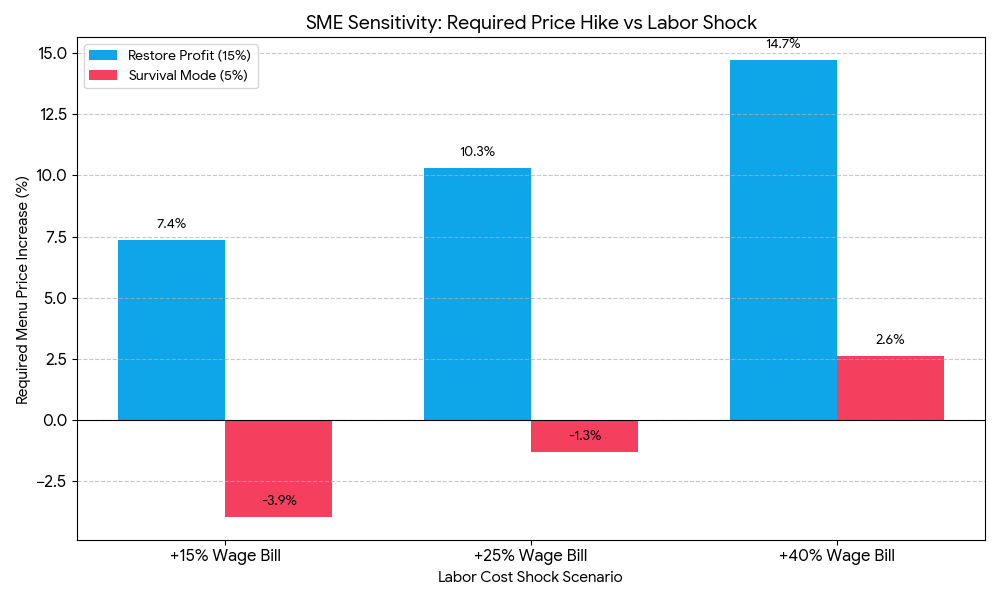
The “Fear Premium” Gap
The Math: As the Blue Bar shows, even in the “Realistic” (+25%) scenario, a price hike of 10.3% is required just to restore original profitability. Without it, net margins collapse to 6.3%.
The Reality: Market observations (e.g., the “Teh Tarik Index”) show prices rising by 20-30%. The gap between the Required Hike (10%) and the Actual Hike (30%) represents the “Fear Premium.” SMEs are pricing in a significant anticipated drop in sales volume.
Methodology: Baseline cost structure (25% Labor, 35% COGS) derived from DOSM Annual Economic Statistics 2024. Baseline 15% margin benchmarked against Retail Group Malaysia Q3 2025 data.
3. The Progressive Wage Policy (PWP): “Raising the Ceiling”
While the Minimum Wage Order establishes a mandatory floor, the Progressive Wage Policy (PWP) is the government’s strategic vehicle to escape the middle-income trap by targeting the “squeezed middle” (earners between RM1,700 and RM4,999). This policy shifts from compliance to a voluntary, productivity-linked model.
3.1 Mechanism: The Incentive-Productivity Nexus
- Voluntary Opt-In: Unlike the statutory minimum wage, participation is discretionary.
- Cash Subsidies: The government provides monthly cash incentives to participating employers: RM200 for entry-level hires and RM300 for existing employees.
- Productivity Condition: To qualify, employees must complete 21 hours of training annually. This ensures wage growth is driven by human capital development rather than inflationary pressure.
3.2 Critical Implementation Challenges
- The “Voluntary Trap”: Financially stressed SMEs, particularly those lacking HR infrastructure, may find the administrative burden of compliance outweighs the monetary incentive, leading to low adoption rates.
- Operational & Rural Friction: For micro-enterprises and those in rural areas, the “opportunity cost” of pulling staff off the floor for training often exceeds the value of the wage subsidy.
- Fiscal Sustainability: The program relies on a finite government budget (e.g., pilot caps). Once allocated funds are exhausted, there is significant uncertainty regarding the continuity of these wage subsidies.
4. The Worker’s Reality: The Living Wage Chasm
The fundamental tension of the 2026 outlook lies in the empirical inadequacy of the RM1,700 minimum wage for urban survival. While employers view this floor as a financial burden, data indicates it falls short of the “survival line” in major economic centers.
- The Quantitative Gap: According to the EPF’s Belanjawanku guide, the basic cost of living for a single adult in the Klang Valley is approximately RM1,970, with a true “Living Wage” benchmarked by Bank Negara at RM2,700–RM3,100.
- The GLIC Distortion: The dissatisfaction is exacerbated by a “two-speed” labor market. Government-Linked Investment Companies (GLICs) have set a RM3,100 wage floor under the GEAR-uP initiative. This creates a psychological benchmark that SMEs cannot match, deepening the “Towkay vs. Worker” class friction as private sector employees compare their statutory minimum against the “gold standard” of state-linked employment.
The “Stagnation” Reality
While businesses worry about survival, workers argue they have been surviving on “2015 wages with 2026 prices.” The gap between productivity growth and wage growth has widened significantly.
- Real wages grew less than 0.5% annually (barely matching CPI).
- Productivity rose 2x faster than wages.
- Fresh grad salaries have remained nearly flat for a decade.
5. Economic Impact Forecast 2026: The Great Filter
Synthesizing the domestic fiscal architecture with international lessons, we can project the economic landscape of Malaysia in 2026. The year will likely function as a ‘Great Filter’, splitting the market into two distinct paths: a ‘Vicious Cycle’ of inflation for those who simply pass costs on, and a ‘Virtuous Cycle’ of productivity for those who automate. This divergence will separate viable, high-productivity firms from those reliant on the historical subsidy of cheap labor.
5.1 Inflation and Growth Dynamics
Despite the cost-push pressures, the official macroeconomic outlook remains cautiously optimistic. The Ministry of Finance projects GDP growth to stabilize between 4.0% and 5.0%, anchored by resilient domestic demand. The theory is that the wage hike transfers capital to households with a high marginal propensity to consume.
However, our simulation reveals a hidden risk. As the Orange Bar indicates, if firms pass through just 25% of the cost shock, the resulting inflation (3.9%) wipes out the real wage growth of the Middle Class (M40). The result is that the “Consumption Boom” could stall as the M40 class sees their purchasing power shrink (-0.9%).
While Bank Negara forecasts headline inflation at a moderate 1.3% to 2.0%, this aggregate figure assumes the wage-price spiral is contained. Our model suggests that if competitive pressures fail to cap price hikes, the “Middle Class Squeeze” illustrated above could dampen the projected growth.
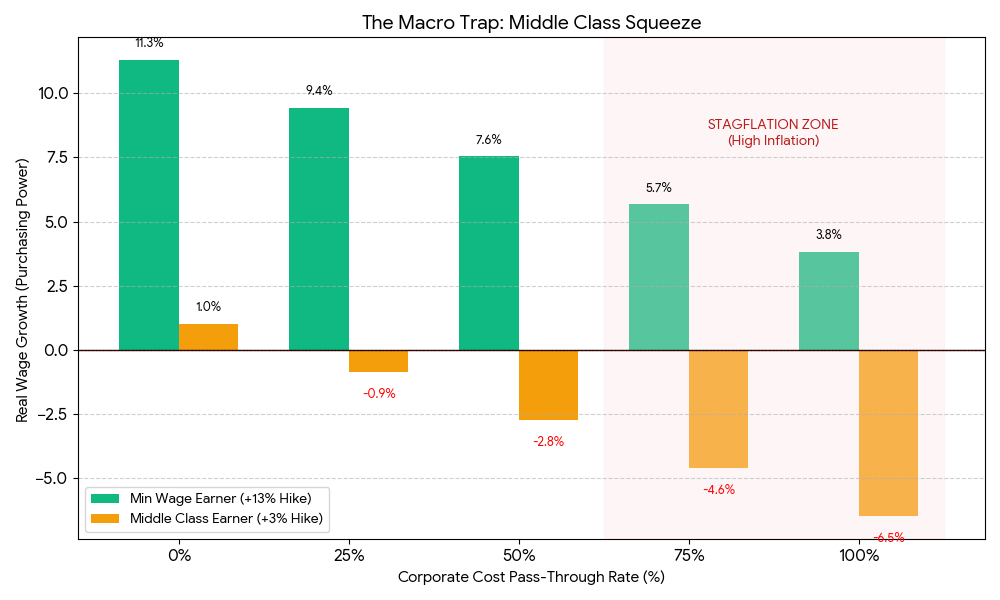
Analyst Note: The “GDP Paradox” Our simulation uncovers a structural flaw in the official 4-5% GDP forecast. The government assumes the wage hike boosts consumption. However, our data shows that if the “Middle Class Squeeze” occurs (Orange Bar), the M40’s disposable income actually shrinks. Since the M40 drives >50% of national consumption, a “pass-through” inflation rate above 25% could cause GDP growth to miss targets, decoupling the “wage boom” from actual economic expansion.
5.2 The Insolvency Outlook
Global insurers like Allianz Trade predict a rise in business insolvencies by +6% in 2025 and +5% in 2026 globally, driven by the “post-stimulus” reality of high interest rates and wage costs. In Malaysia, this trend will likely be amplified in the retail and F&B sectors. The “Chin Chee Seong” scenario of a 30-50% profit plunge suggests that firms operating on margins below 10% will face a liquidity crisis. We can expect a wave of consolidation: individual “mom-and-pop” shops may close, while larger chains with the capital to invest in automation (kiosks, central kitchens) will capture market share.
5.3 The Automation Imperative and Labor Substitution
The 2026 policies create a powerful economic incentive for “capital deepening.” With the 50% tax deduction for AI and automation expenses, the relative cost of technology is falling just as the cost of labor is rising.
- Manufacturing: Will accelerate the shift to robotics, reducing reliance on the foreign workers who are now subject to the EPF mandate.
- Services: Will see increased adoption of QR-ordering, self-checkout, and AI customer service.
While this raises long-term productivity (Raising the Ceiling), it poses a medium-term risk of technological unemployment for older, low-skilled workers who cannot navigate the PWP’s training requirements.
6. Sectoral Deep Dives
2026 Forecast: Sector Readiness
Who Wins, Who Loses?
Already pay above minimum. Impact is minimal. Focus is on retention rather than compliance.
Heavy reliance on foreign labor. Will likely accelerate Industry 4.0 automation to offset wage bills.
Labor intensive with thin margins. Highest risk of closure or passing costs to consumers (Inflation trigger).
6.1 Manufacturing
The manufacturing sector faces the "double whammy" of the minimum wage hike and the foreign worker EPF mandate. As a sector heavily reliant on foreign labor (often >30% of workforce), the EPF mandate alone acts as a 2% (eventually 13%) surcharge on the wage bill.
- Outlook: Export-oriented manufacturers (E&E) will absorb this through efficiency gains or passing costs to global buyers. Low-end manufacturing (furniture, textiles) will struggle, leading to potential factory closures or relocation to cheaper jurisdictions like Vietnam or Indonesia.
6.2 Services (F&B and Retail)
This sector is the epicenter of the viral backlash. It is labor-intensive and has low barriers to entry, making it hyper-competitive and price-sensitive.
- Outlook: Prices will rise. The RM5 nasi lemak may become RM7. We will see a bifurcation: premium outlets that can charge for service, and budget outlets that eliminate service entirely (self-service). The "middle ground" dining establishment that offers full service at low prices will become economically unviable.
6.3 Construction
Construction relies almost exclusively on foreign labor for groundwork. The EPF mandate and wage hike will directly inflate project costs.
- Outlook: This cost inflation will likely be passed on to property buyers, potentially putting upward pressure on house prices, further exacerbating the cost-of-living crisis the wage hike was meant to solve.
7. Strategic Recommendations and Conclusion
The 2026 salary adjustment is a decisive, if painful, step toward maturing the Malaysian economy. It effectively declares the end of the "low-wage, low-cost" comparative advantage that defined the nation's growth for decades.
Rather than a simple checklist, the 2026 landscape presents distinct adaptation curves for each stakeholder. Our analysis suggests that success will be defined by how quickly these groups recognize the structural shift.
- The Regional Asymmetry (Policymakers): The current monolithic RM1,700 floor creates a significant economic friction between the Klang Valley and rural regions. Observations suggest that without a regional coefficient, the policy risks crushing rural economies in Sabah and Sarawak, where the cost of living—and the capacity to pay—differs vastly from Kuala Lumpur. A "one-size-fits-all" approach may inadvertently accelerate rural insolvency.
- The Capital Pivot (SMEs): The market signals clearly that the era of cheap labor has concluded. Data indicates that SME survival will depend on maximizing utilization of automation tax breaks. However, a credit paradox looms: as margins compress (per our Unit Economics Model), traditional bank financing may tighten just when firms need it most. Access to the RM50b government guarantees will be the literal lifeline.
- The Skills Premium (Workers): The gap between the RM1,700 statutory floor and the RM3,000 living wage remains the central challenge for the workforce. The data implies that the minimum wage serves only as a safety net, not a ladder. Upward mobility in this new cycle appears strictly tied to participation in PWP training modules, establishing skills certification (RPA) as the new, non-negotiable currency of the labor market.
8. Conclusion
The tension witnessed on social media is the heat of structural transformation. The "towkay" is not necessarily a villain, but a relic of an economic model that Malaysia is actively dismantling. The worker is not "demanding," but responding to a cost-of-living reality that the statutory floor can barely cover.
Budget 2026 is a gamble that the shock of higher wages will force productivity gains rather than destructive inflation. The international evidence suggests this is possible, but only if the transition is supported by massive upskilling and a ruthless but necessary consolidation of inefficient capital. 2026 will be a difficult year of adjustment, but it is the necessary fire through which the Malaysian economy must pass to forge a high-income future.